🚀 Supercharge your YouTube channel's growth with AI.
Try YTGrowAI FreeCould Not build Wheels for Numpy(Solved)


Pip’s `error: failed-wheel-build-for-install` summary can appear without explaining what went wrong. I wanted to separate the failed stage from the cause behind it.
Read the build output for the package name. You can compare it with the earlier error to interpret pip’s summary.
What a wheel-build error tells you
The pip message error: failed-wheel-build-for-install means pip could not build an installable wheel for at least one requirement. The package name and earlier error identify the cause.
A wheel is a built package distribution tagged for a Python interpreter and platform. If pip cannot select a compatible wheel, it may build one from a source archive through the package’s PEP 517 build backend, as pip’s installation documentation describes, so the failure may belong to NumPy or another requirement.
| Log line | What it tells you | What to inspect |
|---|---|---|
| A filename ending in .whl | Pip found a built distribution candidate. | Check that it matches the active Python and platform. |
| A filename ending in .tar.gz | Pip selected a source archive and will build locally. | Read the build output for the first failed package or command. |
| Failed building wheel for a package | The named package’s wheel build failed, which may be a dependency. | Find the first compiler, backend, or compatibility error above the summary. |
Check Python and pip in the same environment
Run these commands in the environment where you want NumPy installed. The second command shows which pip belongs to that Python interpreter.
python --version
python -m pip --version
If you use a virtual environment, activate it before running either command. Using python -m pip keeps the installer tied to the Python whose version you just checked.
Install NumPy with a compatible interpreter
Keep the same interpreter for the repair and the import check. Upgrade pip only when it is stale, then install NumPy through that interpreter.
Step 1: Upgrade pip only when needed
A current pip understands modern wheel tags and package metadata, so an upgrade can fix old installer behavior. It cannot add a missing system compiler or make an unsupported Python and NumPy release compatible.
python -m pip install --upgrade pip
I ran this in the test environment, where pip 26.2.1 was already installed. If your pip is current, move on instead of changing other packages at random.
Step 2: Install NumPy through that Python
Use the Python command you checked above so pip resolves packages for the intended environment.
python -m pip install numpy
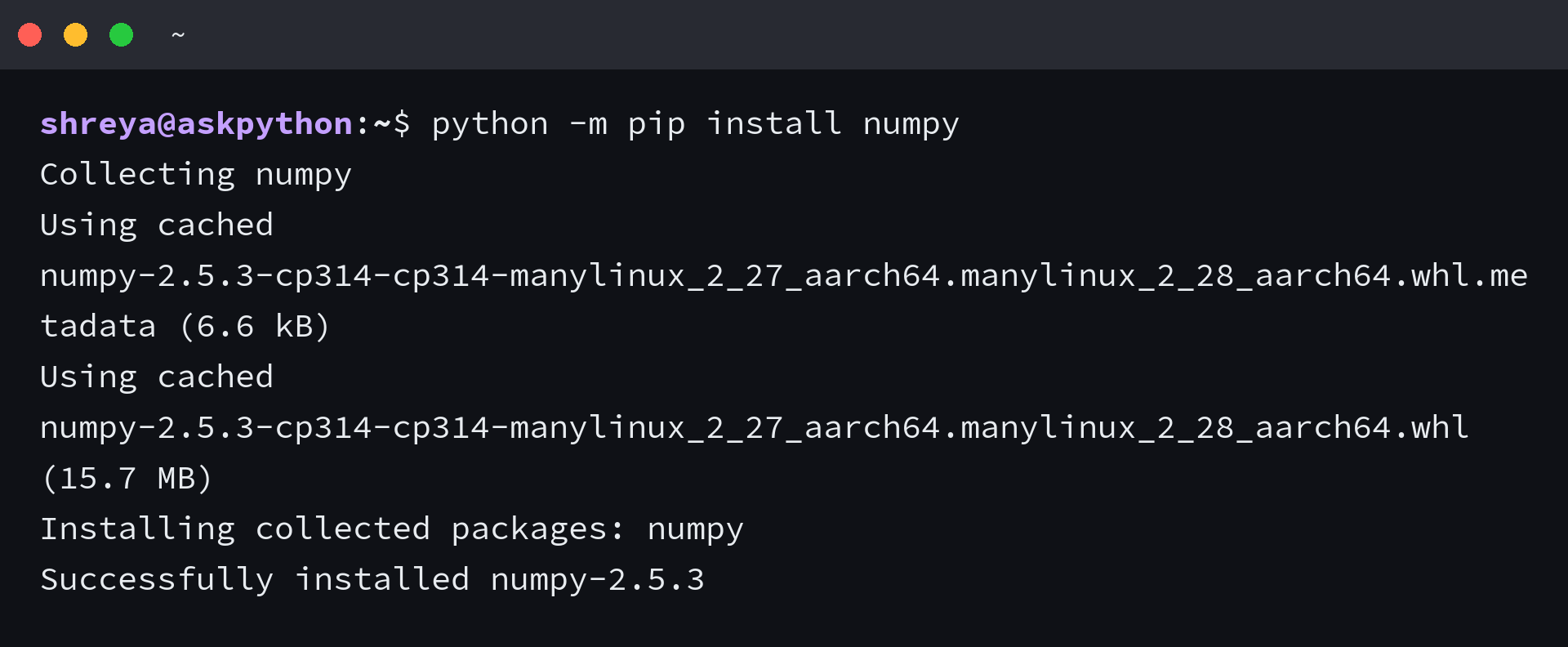
I installed NumPy in a fresh Python 3.14.7 environment, and pip 26.2.1 selected the NumPy 2.5.3 CPython 3.14 AArch64 wheel instead of compiling it. That confirms this Python and platform have a compatible wheel, not that every machine does.
Step 3: Verify the import
Run this with the same Python after pip finishes. It prints the installed version and a small array result.
python -c 'import numpy as np; print(np.__version__); print(np.array([1, 2, 3]) * 2)'
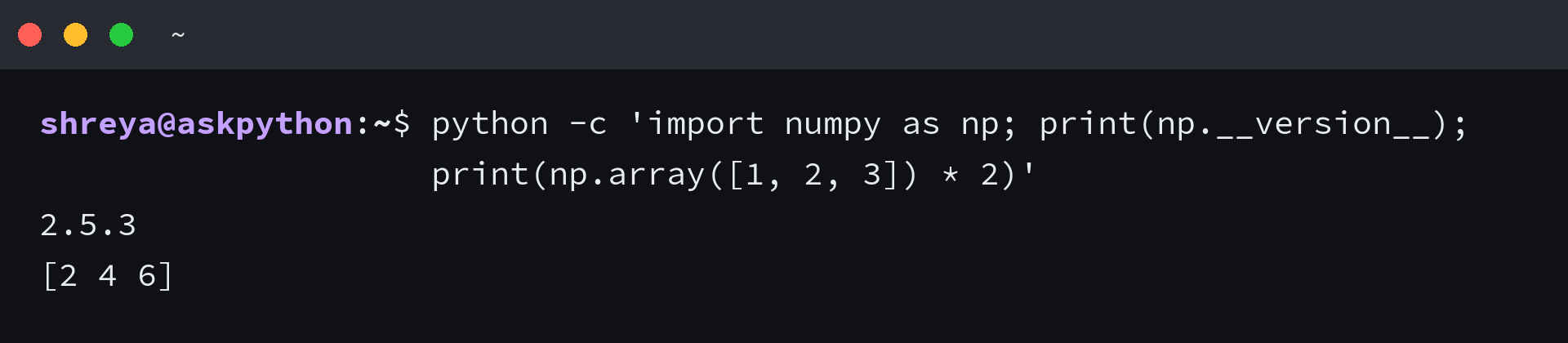
The import test printed 2.5.3 and [2 4 6] in my run. Once it works, continue with the NumPy arrays guide for a first array operation.
When pip falls back to building from source
A source build needs the package’s build backend and any native tools that package requires. The first failing line identifies which kind of repair is relevant.
- If the build section names a dependency, inspect that package’s error rather than changing NumPy first.
- If the output names a missing compiler, header, or system library, install that specific build requirement for your operating system.
- If Python or platform tags do not match an available wheel, use a supported Python and package combination because NumPy 2.5.3’s current PyPI metadata requires Python 3.12 or newer. Python 3.11 needs an earlier compatible release only if your project permits one.
- If the output says no matching distribution was found, pip did not find an acceptable candidate. That is a resolution or compatibility problem, not a compiler failure.
The Python Packaging User Guide explains wheel compatibility tags, so you can check whether a file matches your interpreter and platform.
NumPy’s installation guide recommends a binary package when one is available. It treats building from source as an advanced task because the package may need native build tools.
Upgrading pip may help when an old installer misses available distributions, but it will not repair a failed compiler or unsupported package requirement. Removing an existing NumPy install does not change the wheel, Python compatibility, or build requirements pip can use.
Start with the first failed build line
The final pip message tells you the build failed, while the first error above it tells you what to change. If that line is hard to spot, add -v to increase pip’s log detail, so you can inspect the package’s build output.
python -m pip install -v numpy
Questions about NumPy wheel builds
A failed wheel build stops installation before pip can import NumPy.
Does failed-wheel-build-for-install always mean NumPy failed?
No. Pip may be reporting a failed build for a dependency, so check the package named in the build section before changing NumPy.
Will upgrading pip fix the NumPy wheel error?
It can help an outdated pip select compatible distributions, but it cannot supply a missing compiler or make an unsupported Python and package combination compatible.
Should I uninstall and reinstall NumPy?
No. Reinstalling does not change the available wheel, Python compatibility, or native build requirements.