🚀 Supercharge your YouTube channel's growth with AI.
Try YTGrowAI FreeThe Security Boundary Python LLM Apps Often Miss

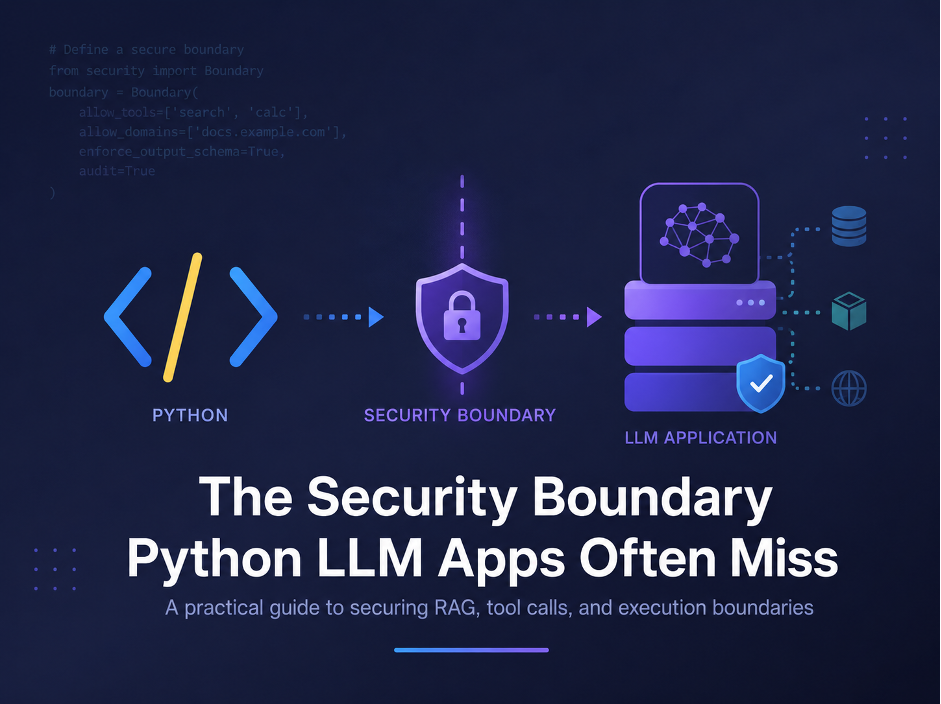
Python makes it remarkably easy to turn a large language model into an application. A few functions can connect an LLM to a vector store, internal documents, APIs, databases, or business tools. That speed is one reason Python has become so central to RAG systems and AI agents.
It also creates a subtle security problem. Developers often focus on whether a prompt is safe or whether the model produces an acceptable answer. In production, the more important boundary is usually somewhere else: the point where untrusted natural language is allowed to influence trusted code, data, or actions.
A useful rule is to treat model output the same way you would treat any other untrusted input. The LLM can recommend, classify, or propose an action. The application should decide what is actually allowed to happen.
When model output crosses into code
A Python application becomes more consequential when model output is passed into another function, especially when that function has authenticated access to data or services.
Consider an agent that can search files, issue refunds, query a CRM, or send email. The risky step is not necessarily the model call itself. It is the transition from generated text to an authenticated capability. If a model can choose a function name, construct arguments, and trigger execution, then natural language has become part of the application’s control plane.
That changes the threat model. The developer has to ask not only “Can the model be manipulated?” but also “What can manipulated output reach?” A system with weak prompt controls but no sensitive capabilities may be less dangerous than a well-prompted agent with broad permissions and automatic execution.
RAG introduces a second source of instructions
AskPython’s guide to RAG applications with Python explains the normal retrieval flow well: retrieve relevant documents, place them into context, and let the model answer from that material. The same architecture creates an important trust issue. Retrieved content is data from the application’s point of view, but the LLM reads it as language, and language can contain instructions.
That distinction is easy to miss. A document can be perfectly legitimate for a human reader and still contain text that changes model behavior when inserted into a prompt. In 2026, a Wharton Generative AI Labs report on hidden prompt injections in AI-assisted grading showed that instructions embedded in submitted work could influence model evaluations. The lesson extends beyond grading: once external content enters an LLM context, the application should assume that some of it may try to compete with the developer’s instructions.
For Python developers, the practical implication is architectural. Retrieval code should track where content came from, preserve source boundaries, and avoid treating retrieved text as if it were trusted system logic. Sensitive actions should never become permissible merely because a retrieved document says they are.
Tool calls are capability grants
Function calling can make an LLM application feel deterministic because the model returns structured arguments rather than prose. Structure helps, but it does not make the decision trustworthy. A JSON object can still contain an unsafe action.
The safer pattern is to separate suggestion from authorization. The model may propose refund_order(order_id=123), but Python code should independently verify that the user can access that order, the refund is within policy, and the requested amount is valid. The same applies to file access, database queries, shell commands, cloud actions, and outbound messages.
This is where LLM Security becomes an application-design problem rather than a prompt-writing problem. The model, its context, user input, retrieved content, plugins, tools, and output handlers all participate in the security boundary. Strong controls therefore sit around the model as well as inside the prompt.
Keep policy outside the model
One of the most useful design principles is to put non-negotiable rules in ordinary Python code. If an action must never exceed a certain amount, access a prohibited path, or run without user confirmation, enforce that with code the model cannot rewrite through conversation.
A simple dispatch layer is often more defensible than letting an agent execute arbitrary tool names. Keep an allowlist of approved functions, validate every argument against a schema, apply user and resource permissions, and require explicit confirmation for high-impact actions. The model can still choose among permitted options, but it does not define what permission means.
This makes security testable in code rather than dependent on proving that a prompt will resist every future phrasing of an attack.
Test the seams, not just the prompts
LLM testing often overweights jailbreak prompts and obvious malicious input. Those tests are useful, but production failures frequently appear at the seams between components: retrieval and generation, generation and parsing, parsing and tool selection, or tool selection and execution.
A better test suite asks what happens when retrieved text contains instructions, when the model returns unexpected fields, when arguments are technically valid but unauthorized, when a tool returns sensitive data, or when one harmless-looking step enables a more privileged second step. These are software-engineering questions as much as AI questions.
The key metric should be consequence, not merely model compliance. A model may follow a malicious instruction, but if the surrounding application refuses the resulting action, the security control still worked. Conversely, a model can appear well-behaved while an overly permissive execution layer quietly creates risk.
Secure LLM apps like software, not conversations
An LLM application is best treated as a software system with a probabilistic component inside it. Python developers already know how to validate inputs, restrict permissions, isolate services, log actions, and fail safely. Those practices become more important when part of the program can be influenced through natural language.
Prompts still matter, and model-level safeguards still matter. But neither should be asked to carry the full security burden. The durable boundary is the code that decides what data the model can see, what capabilities it can reach, and which proposed actions are actually allowed to execute.