🚀 Supercharge your YouTube channel's growth with AI.
Try YTGrowAI FreePython OrderedDict: When to Use It

When you store values by key, you may also need to control the order in which those keys appear. Python’s OrderedDict keeps that order and lets you move keys to either end.
I’ll show how to reorder and remove endpoint items, and when dict is enough.
TL;DR
Use Python’s OrderedDict when your code needs to move keys between ends or compare two mappings with order included.
- Built-in dict preserves insertion order in Python 3.7 and later.
- OrderedDict adds move_to_end() and popitem(last=False).
- Choose it when endpoint changes or order-sensitive equality are part of the job.
What Is Python OrderedDict?
An OrderedDict stores items in the order its keys were added.
Since Python 3.7, dict insertion order is guaranteed.
The constructor accepts a mapping, keyword arguments or an iterable of pairs.
- fromkeys(): Build keys from an iterable with one default value each. Later assignments can supply specific values.
- Equality: Two OrderedDict objects compare order as well as contents. Comparisons with other mappings check contents without order.
- Reverse iteration: Python 3.8 and later supports reversed(ordered) for keys or reversed(ordered.items()) for pairs. The mapping stays unchanged.
When code only needs a standard mapping, dict(ordered) makes a plain dict copy. Its items keep their sequence in Python 3.7 and later, but the copy no longer has move_to_end() or order-sensitive equality with another OrderedDict. Convert only at a boundary where those behaviors are no longer needed.
An empty OrderedDict is valid for keys added as they arrive. Update existing values in place without changing position, or delete and reinsert a key to place it after the remaining entries.
For more collection types, see Python collections. If the task is alphabetical or value sorting, use the separate guide to sorting a Python dictionary.
How to Reorder and Remove OrderedDict Items
Use this ordered mapping to combine direct lookup with changes to its endpoint sequence.
Step 1: Create the ordered mapping
Import OrderedDict and pass pairs in the order you want them stored.
Direct iteration over an OrderedDict yields keys. Use items() when processing each key together with its value, or values() when the key is not needed.
from collections import OrderedDict

items = OrderedDict([("first", 1), ("second", 2), ("third", 3)])
items.move_to_end("first")
print(list(items.items()))
print(items.popitem(last=False))
print(list(items.items()))
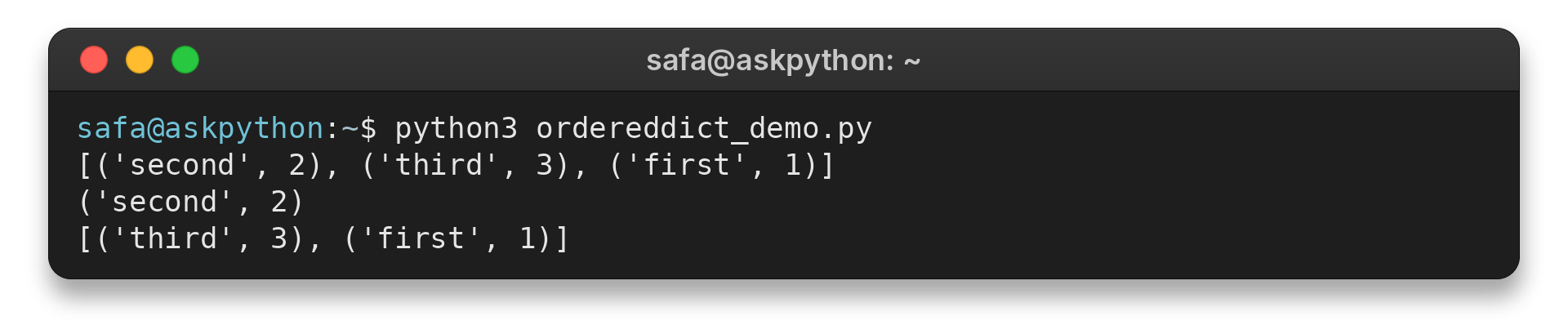
The output from python3 ordereddict_demo.py is:
[('second', 2), ('third', 3), ('first', 1)]
('second', 2)
[('third', 3), ('first', 1)]
The first call moves first to the right end. The next call removes the leftmost pair, second, and returns it. I ran this exact program, and its terminal output is shown here.
Step 2: Choose which end to move
Call move_to_end(key, last=True) to place an existing key at the right end, or pass last=False for the left end. Its value stays attached to the key.
Step 3: Remove the desired endpoint
OrderedDict.popitem(last=True) removes the rightmost pair, while last=False removes the leftmost pair. These modes are last-in, first-out and first-in, first-out, respectively.
A bounded queue or recent-use cache can combine keyed lookup with eviction from one end. Such a cache still needs an explicit capacity and miss policy, along with synchronization if multiple threads share it.
Edge Cases and Choosing dict
Use dict when only insertion order matters. Choose OrderedDict when code must move keys between endpoints or compare sequence as part of equality.
Endpoint methods have two common failure states:
| Case | Symptom | Fix |
|---|---|---|
| move_to_end() gets an absent key | KeyError: ‘missing’ | Check key in ordered first or handle KeyError. My probe produced this exact exception. |
| popitem() gets an empty mapping | KeyError: ‘dictionary is empty’ | Check whether the mapping contains items before removing an endpoint. |
A list cannot be a key because it can change after insertion. A tuple of hashable values can serve as one.
A plain dict can remove its rightmost pair with popitem(), and assigning dict[key] = dict.pop(key) moves a key to the right. Use sorted() on pairs first when alphabetical or numeric order is required. Sorting establishes only the initial sequence, and later insertions append unless the code explicitly repositions them.
Conclusion
Use each mapping according to the ordering behavior its caller expects. Consult the OrderedDict documentation and dict documentation for method details.
FAQ
These answers summarize when OrderedDict differs from a regular mapping.
Do Python dictionaries keep insertion order?
Yes. The language guarantees insertion order for dict starting with Python 3.7.
How do I move an OrderedDict key to the beginning?
Call ordered.move_to_end(key, last=False). The key must already exist.
How do I remove the first OrderedDict item?
Call ordered.popitem(last=False). It returns and removes the leftmost key-value pair.